
AI tutoring tools are easy to access, quick to answer, and increasingly common in schoolwork. For parents, that raises a practical question: can an AI tutor give a K–12 student the support they need, or is a human tutor still the better choice?
The answer depends on what a student needs. AI can be useful for extra practice and quick explanations. But when a student is stuck, losing confidence, or needs someone to identify why a concept is confusing, a human tutor can offer something technology cannot reliably provide: responsive teaching, personal connection, and accountability.
For most students who need sustained academic support, personalized tutoring with a real educator is the stronger foundation. AI can help as a supplement, when used thoughtfully.
What do we mean by an AI tutor?
“AI tutor” can refer to different kinds of tools. Some educational platforms adapt practice questions based on a student’s responses. Generative AI chat tools, by contrast, produce answers and explanations in response to a student’s prompts. Their features and safeguards vary, so “AI tutoring” is not one uniform approach.
A well-designed practice tool may offer immediate feedback, repeat questions, or adjust difficulty. That can make it convenient for independent review, especially when a student already understands the topic and wants more chances to practice.
But an instant response is not necessarily the same as instruction that fits a learner. If a student asks for the answer, a tool may supply it without ensuring the student can solve a similar problem independently.
Where AI tools can help
AI tools can be useful for low-stakes practice: generating another example, reviewing a familiar step, or helping a student phrase a question to take to class. A structured tutoring system may also provide a steady stream of practice and feedback.
Research on intelligent tutoring systems (software designed to adapt instruction to a learner) is encouraging but mixed. A 2025 systematic review of 28 K–12 studies found generally positive effects on learning and performance. However, results were less clear when these systems were compared with other tutoring software, and the authors called for longer studies and more diverse samples. The review does not establish that AI is better than a skilled human tutor.
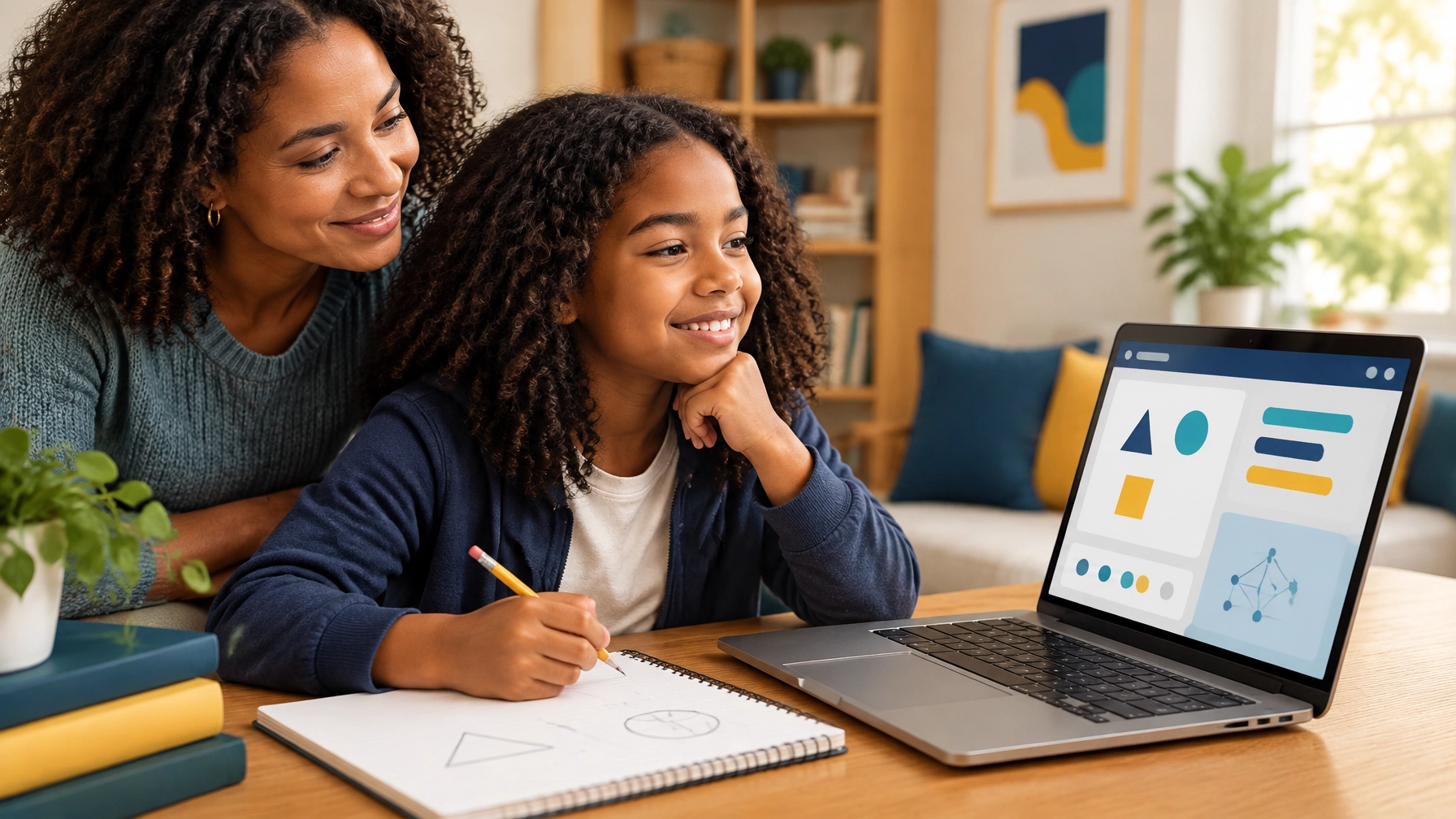
For families, this means AI may be a helpful practice aid, but it should not be treated as proof that a student has mastered a skill. Ask your child to close the tool and try a fresh problem on their own. If they cannot explain the steps or repeat the process independently, more teaching may be needed.
What a human tutor adds
A human tutor can listen to a student’s explanation, ask follow-up questions, and change course when an approach is not working. They can notice when a learner is applying the wrong rule, guessing, or becoming frustrated, and respond with a different example or a simpler explanation.
That kind of interaction matters in math and science, where one missed foundational idea can make later topics feel harder. A student may say “I don’t get fractions,” when the real obstacle is an earlier concept, like equivalent values or multiplication. A tutor can investigate the thinking behind the answer rather than simply respond to the question as written.
Human tutors also create a relationship and a routine. A student can return to a familiar educator, review what was challenging last time, and work toward a shared goal. That can support persistence and make it easier for a parent or guardian to understand what the student is practicing and what might need attention next.
This is why many families looking for an online math tutor for kids are not just looking for a source of answers. They want a person who can explain, listen, and adjust, and help a child become more independent over time.
A reason to use AI with care
A 2025 study published in PNAS examined GPT-4 tutoring in mathematics at one high school in Turkey. Students performed better on practice problems when they had access to AI. But the group using a basic, answer-producing version performed worse on a later test without AI than students who practiced without it. A version designed to give hints instead of answers did not show the same negative effect, but it did not outperform the no-AI group on that test.
The findings are a caution, not a verdict on every tool or student. The study took place in a specific school, with specific tools and lessons. Still, it highlights an important difference: finishing a problem with assistance is not the same as learning to solve it alone.

A useful rule for families: ask whether the tool prompts a student to think, or makes it easy to skip the thinking. Hints, guiding questions, and requests for students to explain their reasoning are generally more learning-focused than simply revealing a completed solution.
AI tutor vs. human tutor: a practical comparison
| Need | AI tool may be useful for | Human tutor is better positioned to |
|---|---|---|
| Extra practice | Offer additional questions or quick review | Choose practice that targets a specific misunderstanding |
| Immediate feedback | Respond quickly to a prompt | Explain why a mistake happened and adapt the explanation |
| Confidence and motivation | Make solo review feel more approachable for some students | Build a supportive relationship and encourage persistence |
| Independent mastery | Provide hints if designed to do so | Check whether the student can solve a fresh problem without support |
| Accountability | Track activity in some platforms | Help set learning goals and follow up on progress with the student |
The comparison is not that every human tutor is effective or every AI tool is ineffective. Quality, fit, and the student’s needs matter. The key difference is that a human educator can use judgment in the moment and respond to context that may not appear in a prompt or a set of answers.
Questions parents can ask before choosing
Whether you are considering AI, tutoring, or both, start with the learning need:
- Can my child explain what they find difficult?
- Do they need more practice, a different explanation, or a review of prerequisite skills?
- Can they solve a similar problem without help after using a tool?
- Does the AI tool offer hints and reasoning prompts, or mostly answers?
- What information does the platform collect, and how is student data handled?
- If my child is still stuck, who can help them interpret the problem?
For younger students especially, consider supervising AI use and checking the platform’s age guidance, privacy practices, and settings. Avoid entering unnecessary personal or sensitive information into AI tools. For schools and youth programs, review data handling, accessibility, adult oversight, and how independent learning will be assessed before adopting a platform.
What about families in Chicago and online?
Families seeking math tutoring Chicago options may be comparing local support with online sessions. The right format depends on the student’s needs, schedule, and comfort with learning on screen. Online tutoring can make it possible to connect with a tutor beyond the local area; it still involves a real educator who can ask questions and adapt the session.
Proof & Progress offers K–12 tutoring in math and science in South Shore, Chicago, and nearby communities, with online tutoring available beyond the local area. Families can explore tutoring details to learn more about the subjects and support offered.
For schools and youth organizations, a tutor or program lead can also help determine how one-to-one or small-group instruction fits into a wider educational program. Proof & Progress works with organizations on institutional tutoring as well as STEM and engineering programs.
The bottom line: use AI as a helper, not the whole plan
AI tools can make practice more accessible and provide quick support. Used well, they can help students review a concept or get started on a question. But for most K–12 students who are consistently struggling, a human tutor is the stronger primary choice: an educator can build understanding through conversation, notice when an explanation is not landing, and check that a student can work independently.
If your child uses AI, encourage them to ask for a hint, explain their own reasoning, and attempt a new problem without assistance. When the confusion persists, or when your child needs ongoing, responsive support, consider personalized tutoring services with a real educator.
Sources: 2025 systematic review of K–12 intelligent tutoring systems in npj Science of Learning; 2025 study of generative AI in high-school mathematics in PNAS.